Cornering on gravel can be intimidating, but mastering the bends is key to riding with confidence and control. Below, Coach Annick breaks down effective braking, body positioning, line choice, and sighting techniques to help you move from “survive” to “thrive” on every turn.
In this Coach’s Corner, we will be talking through tips to help you navigate around those fun bendy parts of the gravel roads that you will inevitably encounter at some point on your rides. Depending on your comfort level with cornering skills, this sign can either spark terror or elation. Hopefully this blog will help you move the dial from survive to thrive if you’re in more of the terror camp, and can even progress your skills and comfort further if you’re in the elation camp.
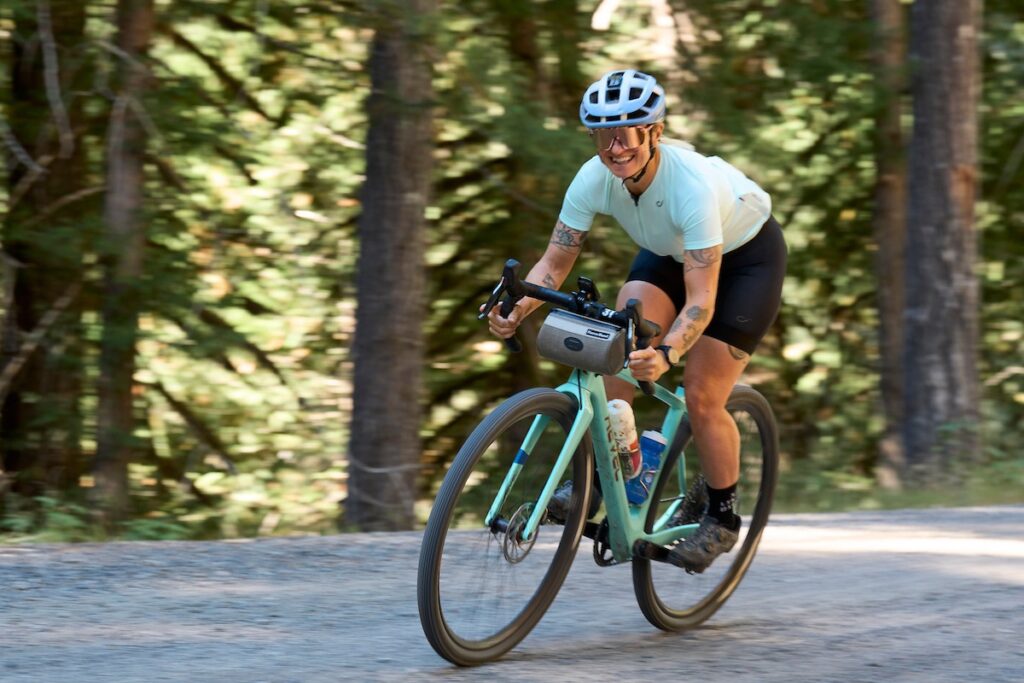
Why does cornering when descending cause so much consternation for so many, especially on unpaved terrain? I think two big, related factors are loss of traction and control. We often brake more than we actually need to (usually favoring only our rear brake) through the corner, making our bike less able to lean and instead turning it into a skidding machine moving in a straight line. We panic and look at the edge of the corner instead of through the corner to the exit. All of that sounds really scary to me! Let’s address a few areas to consider when cornering that should enable more effective braking, better body position and sighting, and improved line choice.
The Approach: Smart & Intentional Braking
Braking – Ideally when approaching a corner we have already noticed it because our eyes are focused on what is ahead (i.e., where we want to go), and we start to slow down using BOTH brakes by gently applying pressure to the brake levers. As we discussed in a previous Coach’s Corner, being in the drops gives us the best access to the full brake lever–this position allows for maximum brake leverage to get the biggest range of braking capacity, using that brake lever like a dimmer switch. Ideally we have finished our braking by the time we get to the apex of our turn. The apex is the middle of the corner’s arc.
Using both brakes will allow us to use less intensity of pressure than if we just used our rear brake. Many people have had a bad braking experience in the past where they had too much front brake and/or unfortunate body position, so they went over the bars. We will revisit this body position topic in a moment. For now the take away is to embrace the front brake… WITH the rear brake. AND if you need to do a little bit of speed modulation as you approach the apex, you can drag the rear brake only, using gentle pressure on the brake lever. We call this the 2-1-none approach. Two brakes, one brake, then no brakes!
Every corner will feel different because of its angle, road steepness, and terrain variability so this mantra may feel more like 2-none on some and 2222222-1111-none on others. All of that is correct and all of it shows progress because you are applying intentionality in your braking. With time and intentional practice, your braking will improve in corners.
The Setup: Body Position (Standing vs. Sitting)
Body position (Standing vs Sitting) – With gravel, more so than with paved roads, we teach options here. If the road surface is more “champagne” gravel and very smooth, you are probably good sitting while you corner. Importantly, you will want the outside foot down (with a straighter leg) applying pressure to that outside pedal, and then hand pressure to your inside handlebar. This enables the bike to lean.
For gravel tires there’s usually special tread on the edges of the tire to help with traction in corners. If you don’t lean the bike you don’t get to deploy these little cornering helpers. If the terrain is a lot bumpier, then you can get off of your saddle by standing on your pedals, with level pedals (i.e., one at 3 o’clock and the other at 9 o’clock) and with a slight bend in your knees, a hinge at the hips, and bend in the elbows. This allows you to both engage your body’s suspension (arms and legs) to absorb those bumps and allows the bike to bump around underneath you without knocking you around.
Sighting: Looking Where You Want to Go
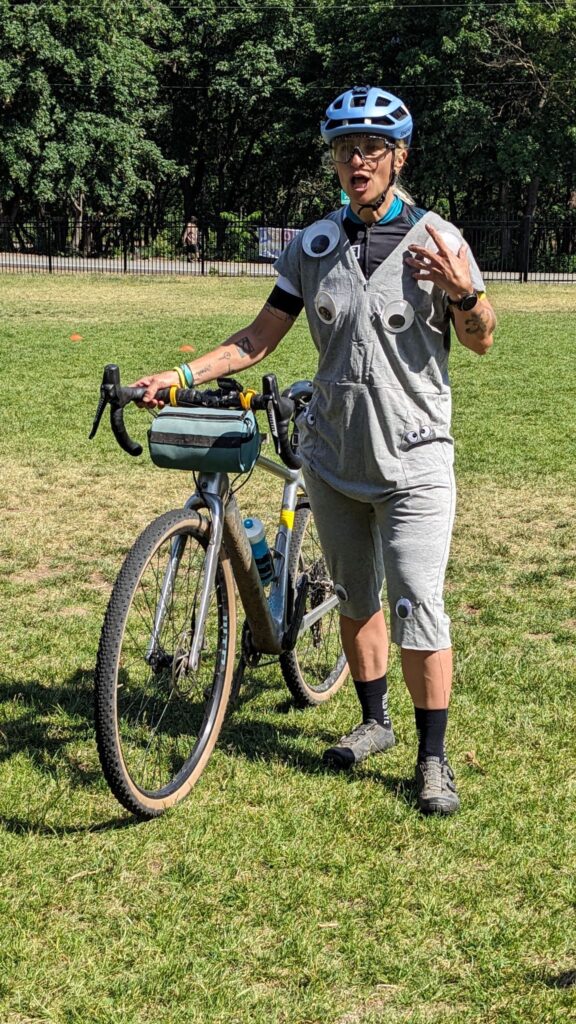
Eyes – Whether you are seated or standing when cornering, it is vital that you look where you want to go. As we enter the corner, we look to the apex; as we get to the apex, we look to the exit. And I like to imagine that there are eyeballs on my shoulders, hips, and even knees, so that all of those eyeballs are looking through the turn along with the eyeballs on my head.
Line Choice: Finding the Smooth Path
Line choice – Ideally when cornering we want to take the straightest line around the corner to retain speed and traction, causing us to go from the outside of the lane to the inside of the lane at the apex and finish at the outside of the lane to exit.
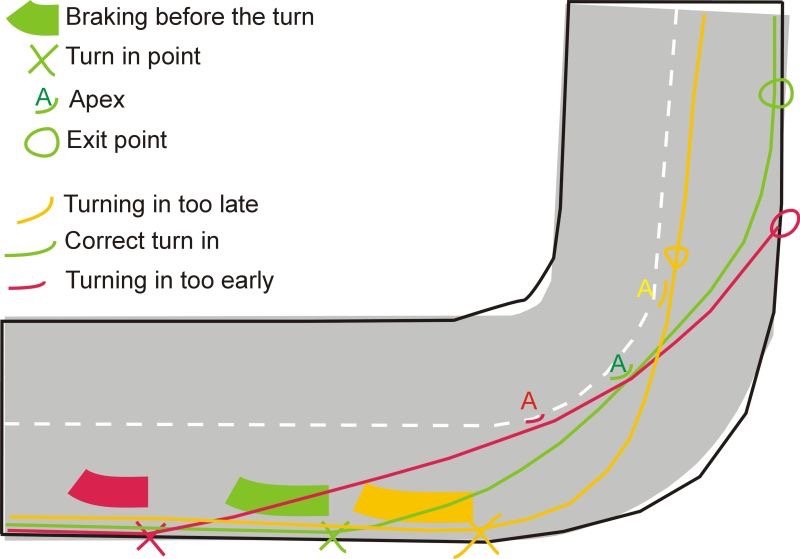
When traveling on unpaved terrain, however, doing all this transiting across the lane can lead you to go from one pile of gravel, through another one, to the other edge’s pile and back through the same set of gravel piles because there are sometimes car tire tracks through the gravel road. This can make achieving the straightest line more treacherous than it’s worth. Straightening your line within the one track can still be an advantage and something to consider.
Annick Chalier is an elite-level cyclist, PMBIA Level 1 certified mountain bike and gravel coach, and the self-proclaimed “Head Unicorn-fun inspirer” of the Pacific Northwest. Calling the Columbia River Gorge home since 2019, Annick has an extensive racing background that spans professional road racing, gravel stage race victories, cyclocross, and endurance mountain biking.
For Annick, riding is about finding a flow state, connecting with nature, and “hootin’ and hollerin’” down the trail with friends. As an Endurance Coach for Special Blend and an integral part of the Brave Endeavors team since 2022, she loves helping riders of all ages unlock newfound confidence on two wheels. Whether she’s coaching kids on mountain bikes or adults on gravel adventures, Annick’s passion for teaching is infectiously powerful.