High on the Cascades by Ian Madin
For 32 years Ian Madin studied Oregon’s landscapes as a geologist with the Oregon Department of Geology & Mineral Industries and since 2013 he has experienced them from the saddle with Cycle Oregon. His evening talks from the camp stage reveal the wonders and surprises of the terrain we ride and are always a crowd favorite. Stay tuned to the blog for this series as Ian takes us day by day through this wondrous region.
Not registered for Rally yet? Do that here.
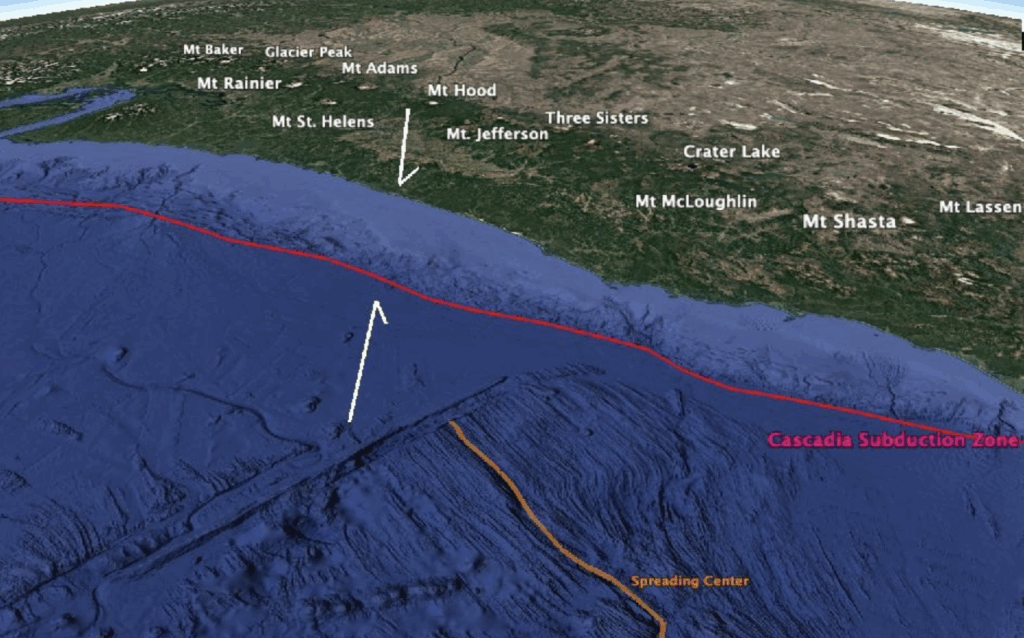
The 2025 Rally route will take us on a tour of the southern Oregon Cascade Range, a beautiful and diverse landscape shaped by fire and ice. We will pass ancient and dormant volcanoes, cross active faults and ride through glaciated valleys. The volcanoes of the Cascade Range are part of a volcanic arc, one of the major features of the plate tectonic engine that shapes the surface of the earth.
The outer skin of the earth is a layer of rigid rock, 5-25 miles thick called the crust. Beneath it is the mantle, a layer of hot rock under enormous pressure that can flow slowly. The mantle is heated from below by the incandescent core of the earth, and that hot rock rises slowly till it reaches the surface where it spreads out, cooling against the crust.
Where this happens, the crust splits, and molten rock fills the crack, cooling to form new crust along an oceanic spreading center. The newly formed crust moves away from the spreading center in both directions. When the moving ocean crust reaches a continent, it slides beneath the edge of the continent in a process called subduction. As the subducting crust sinks it releases water that acts as a flux, causing the mantle above it to melt, feeding a narrow chain of volcanoes called a volcanic arc.

The volcanoes that built the Oregon Cascades are the result of subduction, one of the main elements of the plate tectonic processes that shape the Earth. In Oregon, the sea floor of the Pacific Ocean has been subducting beneath the edge of the North American continent for almost 50 million years. The subduction has been feeding a volcanic arc for that entire time, forming the Cascade Range. The twelve major volcanoes along the arc are evidence that the process continues today.
Our five day journey takes us from the eruption of stratovolcano Mt. Mazama, which leads to the creation of Crater Lake, and rolls us through ash flows, ice flows, remnants of earthquakes and landslides, and the many creations of flowing lava, water and time.
Join us as here on the blog we ride along the arc and visit these wondrous and dynamic places or sign up and see it yourself in the best way possible, by bike. Ride with us.